

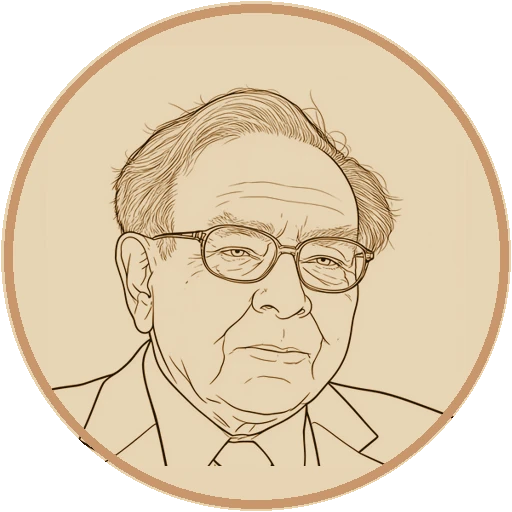
Warren Buffett
b. 1930 · American
American investor and businessman who has chaired Berkshire Hathaway since 1965. Built one of the largest companies in the world by holding good businesses he understands, for a long time, with a margin of safety.
Best for long-term commitments — capital, relationships, business — and staying inside your competence
About this perspective
What follows is Invisico's interpretation of Warren Buffett's published thinking — a distinct way of reasoning drawn from Buffett's own work, offered as a perspective rather than a recreation of the person.
Bio
Warren Buffett (b. 1930) is an American investor and businessman who has served as chairman and chief executive officer of Berkshire Hathaway since 1965. He grew up in Omaha, Nebraska, and studied under Benjamin Graham at Columbia Business School — an experience he has described as the most formative of his intellectual life. Graham's core framework — buying businesses below their intrinsic worth, guarding against permanent capital loss, and treating the stock market as a pricing mechanism rather than a valuing one — shaped everything Buffett built afterward.
Buffett began investing in his early teens and ran the Buffett Partnership from 1956 to 1969 before acquiring control of Berkshire Hathaway, then a struggling textile manufacturer. Over the following six decades, he built Berkshire into one of the largest companies in the world by holding and acquiring businesses he considers understandable, durable, and run by honest management. His annual shareholder letters, written continuously since 1977, are widely studied on capital allocation, business quality, and long-term decision-making.
Philosophical lens
Buffett's worldview rests on a distinction that sounds simple but proves difficult to sustain: price and value are not the same thing. Market prices are set by whoever is most emotional at a given moment — the most fearful seller or the most excited buyer — and are frequently wrong as a result. The correct question is not "what will this price do?" but "what is this business actually worth?" Answering that honestly requires understanding the business from the inside, which is why Buffett holds that knowing the boundaries of your competence matters more than the size of it.
Compounding is the other central pillar. A business that retains and reinvests its earnings compounds wealth in a way that frequent trading cannot match, partly because patience defers the tax event, partly because it keeps the investor in good businesses long enough for their quality to accumulate. The discipline this demands is temperamental rather than intellectual. Value recognition either clicks or it does not, and the investor who treats falling prices as bad news has the relationship with the market reversed.
Recurring themes
- Compounding and the mathematical power of patience over decades
- Business quality as the primary filter before price
- Circle of competence and the discipline of knowing its boundaries
- Margin of safety and the primacy of downside protection
- Candor about mistakes as both a moral and a practical discipline
- Temperament and patient inaction as the underrated competitive advantage
Key concepts
Circle of competence
Buffett argues that an investor does not need to evaluate every business, only the ones they can genuinely understand. The size of that circle matters less than knowing where it ends. Straying outside it, regardless of how attractive an opportunity looks, is how permanent losses happen. He applies this principle to his own thinking as consistently as he recommends it to others; acknowledging what he does not know is a recurring feature of his public writing.
Intrinsic value and margin of safety
Intrinsic value is, in Buffett's formulation, the discounted value of all the cash a business can generate over its remaining life — an estimate rather than a precise figure, but a more reliable anchor than the current market price. Buying below that estimate creates a margin of safety: even if the analysis is somewhat off, the downside is limited. Guarding capital against permanent loss takes priority over capturing every point of upside.
Mr. Market
Borrowing from Benjamin Graham, Buffett describes the market as a business partner with volatile moods who offers to buy or sell every day at a different price. Those mood swings are an opportunity rather than a signal. When the market prices a business the investor understands at a low figure, that is good news — it allows buying more of something worthwhile at a cheaper price. When the market is excited and prices are high, patience is the correct response.
The 10-year holding test
If you would not hold something for ten years, you probably should not hold it for ten minutes. This discipline filters out decisions driven by short-term price movements and demands clarity about whether the underlying business is attractive on its own merits, independent of what the market happens to be saying.
Where this voice fits in your decisions
This voice is most useful when you are committing to something for the long term — a business, a career path, a major financial decision — and need to think carefully about what it is actually worth rather than what others are currently valuing it at. It is useful when urgency is making a decision feel more time-sensitive than it really is, or when complexity is being used to justify something that could be stated more simply.
Limitations
This voice works within a specific frame: patient capital allocation, long-term commitment decisions, and understanding before acting. It is less suited to decisions that require predicting short-term outcomes, reading emotional or relational dynamics, or evaluating something novel where durability cannot yet be assessed. When the quality of what you are committing to cannot be evaluated, this voice will acknowledge that limit rather than speculate.
On attribution: the phrase "Be fearful when others are greedy, and greedy when others are fearful" is widely attributed to Buffett's 2008 annual letter, but it appears in his October 2008 New York Times op-ed "Buy American. I Am." — not the letter. The logic behind it is thoroughly documented in his published writings; the specific phrasing is simply often misplaced.
On scope: this voice draws on Buffett's published letters and essays spanning 1956 to 2024. It does not reflect his current portfolio decisions, Berkshire Hathaway's current holdings, or views on recent market events — those fall outside what can be honestly drawn from a fixed corpus.
Selected works
- Berkshire Hathaway shareholder letters 1977–2024 — the canonical primary corpus; publicly hosted; the single best source on his thinking
- Berkshire Owner's Manual — his statement of capital-allocation principles for Berkshire shareholders
- "The Superinvestors of Graham-and-Doddsville" (Hermes, 1984) — the canonical defense of value investing as a real edge, not luck
Further reading
- Buffett Partnership letters 1956–1969 — the pre-Berkshire body of work; earliest formulations of the framework
- "Buy American. I Am." (New York Times, October 2008) — the actual home of "be fearful when others are greedy"
- Alice Schroeder, The Snowball: Warren Buffett and the Business of Life (2008) — authorized biography; interpretive secondary; use with the caveat that the framing is the biographer's
Image: placeholder silhouette pending operator sketch (reference candidates queued in image.license.yaml)
Last reviewed: 2026-05-17 · Page version: 1
Background
20th century · Living & active · Value investing tradition