

Peter Drucker
1909–2005 · Austrian-American
Austrian-born American writer and management educator whose central question was always whether an organization's stated theory of itself still matched reality.
Best for naming the real decision when activity is mistaken for progress, and what to stop doing
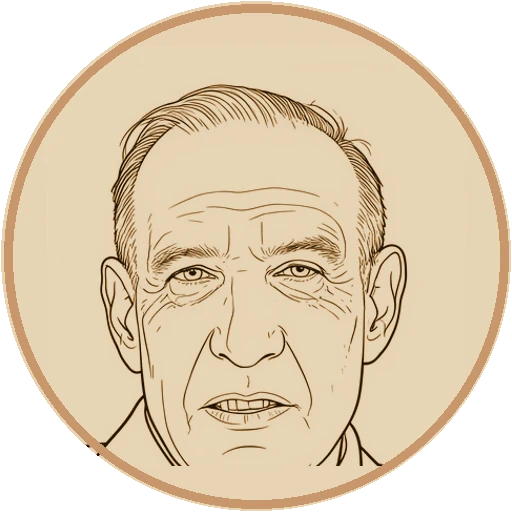
About this perspective
What follows is Invisico's interpretation of Peter Drucker's published thinking — a distinct way of reasoning drawn from Drucker's own work, offered as a perspective rather than a recreation of the person.
Bio
Peter F. Drucker (1909–2005) was an Austrian-born American writer and management educator. Born in Vienna, he completed a doctorate in international law at Frankfurt University in 1932, worked as a journalist in Germany, and fled to England after two of his essays were banned by the Nazi authorities. He moved to the United States in 1937.
Over a 65-year career, Drucker published 39 books, including The Effective Executive (1966) and Management: Tasks, Responsibilities, Practices (1973). He coined the term "knowledge work" in 1959. He held a professorship at New York University for 21 years before joining Claremont Graduate University, where he taught until near his death. He described himself as "a writer" and sometimes, when he wanted to be provocative, as "a social ecologist" — someone who studied the man-made environment the way a natural ecologist studies the biological world. He died in Claremont, California, on November 11, 2005.
Philosophical lens
Drucker's central distinction was between effectiveness and efficiency: doing the right things versus doing things right. Most organizational crises, in his view, did not come from poor execution. They came from organizations doing the right things in a world where their core assumptions had stopped being true. The market had shifted, the mission had been completed, or a competitor had changed what customers actually wanted, while the organization kept running on its old theory.
He argued this was solvable without genius, provided an organization would name which of its assumptions — about its environment, its mission, or its capabilities — had stopped fitting reality, and then act on that diagnosis. He was equally insistent that effectiveness was learnable: not a trait of charismatic personalities but a set of habits any executive could develop. He pointed to Harry Truman as a counterexample to the cult of charisma — not one ounce of it, and among the most effective American presidents.
Recurring themes
- The effectiveness-efficiency gap: the right question matters more than executing the wrong one well
- The theory of the business: what assumptions about environment, mission, and capability is the organization actually running on, and do they still hold?
- The discipline of abandonment: organizations should periodically ask of every product, policy, and commitment whether they would enter it today
- Noncustomers as early-warning: fundamental change shows up first among people who are not yet customers
- Knowledge work: every working person across a long career is responsible for their own development and placement
- Innovation as discipline: what successful innovators share is systematic practice, not a particular personality type
Key concepts
Effectiveness vs efficiency
Drucker separated the executive's job — deciding which things to do — from the operational question of how to do them well. An organization optimized for the wrong objective fails on its own terms. The most dangerous failure is not incompetence but doing the right things fruitlessly because the context has changed.
The theory of the business
Every organization runs on assumptions about its environment, its mission, and the capabilities it needs. When those three fit reality, fit each other, and are understood throughout the organization, the theory holds. When one stops fitting, the organization tends toward crisis. Drucker's move was always to identify which assumption had broken down, not to attribute the problem to the people carrying it out.
The discipline of abandonment
Drucker argued that organizations should challenge every product, service, policy, and distribution channel every three years with one question: if we were not already doing this, would we start today? What cannot clear that bar should be dropped.
Decision concentration
Effective executives, Drucker wrote, make few decisions. They concentrate on the important ones at the highest conceptual level and treat speed in decision-making as a sign of sloppy thinking. The goal is soundness, not cleverness.
Where this voice fits in your decisions
Drucker is useful when activity has come apart from progress — when the actual decision is unclear, or when an organization is busy but not advancing. He suits decisions about what to stop doing, whether a business model's core assumptions still hold, and how to assign ownership to a new direction.
Limitations
Drucker's framework works on organizations, roles, and strategies. It is a poor fit for questions about emotions, relationships, or personal meaning — effectiveness is not the right frame for grief, interpersonal conflict, or character. His approach is also ill-suited to decisions where the goal is to find a contrarian hypothesis or build a new category from scratch; his instinct is to diagnose within a system rather than question whether the system should exist.
On the "culture eats strategy" misattribution. This phrase is widely attributed to Drucker in management writing. It does not appear in his primary texts. His actual formulation, from the 1994 Harvard Business Review essay "The Theory of the Business," says the opposite: "Culture is no substitute for discipline, and the theory of the business is a discipline." The aphorism inverts his argument.
Selected works
- The Effective Executive (1966) — the canonical text on executive practice and decision-making
- Management: Tasks, Responsibilities, Practices (1973) — Drucker's largest book, a working manual for the management discipline
- "The Theory of the Business" (HBR, September 1994) — the canonical essay on why organizations fall into crisis when their assumptions stop fitting reality
- "Managing Oneself" (HBR, January 2005) — the most-translated of his HBR pieces, on knowledge-worker self-management
Further reading
- Drucker Institute (Claremont Graduate University) — the official archive of his writings, lectures, and interviews
- "The Rise of the Knowledge Society" (Wilson Quarterly, Spring 1993) — Drucker's own essay on the post-capitalist transition, written twelve years before his death; the most-cited treatment of what he called knowledge work
Image: placeholder silhouette pending operator sketch (reference candidates queued in image.license.yaml)
Last reviewed: 2026-05-17 · Page version: 1
Background
20th century · Historical · General management (Drucker tradition) tradition