

Marcus Aurelius
121–180 CE · Roman
Roman emperor and Stoic philosopher whose private notebooks remain the most cited working manual for governing oneself under sustained pressure.
Best for decisions made under pressure where ego or fear distorts judgment, duty, and self-command
About this perspective
What follows is Invisico's interpretation of Marcus Aurelius's published thinking — a distinct way of reasoning drawn from Aurelius's own work, offered as a perspective rather than a recreation of the person.
Bio
Marcus Aurelius (121–180 CE) was a Roman emperor and Stoic philosopher who ruled from 161 CE until his death. He began studying philosophy at twelve, working under the rhetorician Fronto and later the Stoic Junius Rusticus. His reign was marked by sustained crisis: the Antonine Plague, repeated barbarian incursions along the Danube frontier, and a civil war launched by the general Avidius Cassius in 175 CE. He spent much of his later years on military campaign rather than in Rome. Cassius Dio, writing in the following century, praised him for surviving these difficulties and preserving the empire without resorting to flattery or fear.
The Meditations, written in Greek as private notes during the campaigns, are the principal record of his thought. Originally titled "To Himself" (Eis heauton), they were not intended for publication and read as a practitioner's working notes rather than a philosophical treatise. Scholars regard Marcus as a committed Stoic and the last notable Stoic of antiquity, though not an original theorist. His contribution was the disciplined practice of existing Stoic doctrines under extraordinary pressure, not the development of new ones.
Philosophical lens
Marcus held that inner character — the four cardinal virtues of justice, temperance, courage, and freedom — is the only unqualified good. He treated everything external (wealth, reputation, power, comfort) as an "indifferent": something that may have instrumental value but no intrinsic worth. What troubles people, on his account, is not events themselves but the judgments they attach to those events. Since those judgments are within one's control, emotional distress is addressable at the level of thought rather than by changing external circumstances.
His Stoicism was fundamentally social. The inner discipline he practiced was not withdrawal but the precondition for just action toward others. His method drew on three disciplines from Epictetus: distinguishing what is and is not within one's control (desire); identifying what just conduct requires in a given situation (impulse); and stripping events back to what they actually are, without the added value-judgments that generate distress (assent). The "view from above" — mentally expanding one's perspective to the scale of the whole cosmos and of time — was his main tool for deflating fears and attachments that had grown larger than the facts warranted.
Recurring themes
- The dichotomy of control: separating what is genuinely within one's power from what is not
- Virtue, particularly justice, as the only unqualified good — wealth, reputation, and comfort are indifferents
- Mortality as a clarifying tool for present priorities, not a counsel of despair
- Duty and role-obligation: performing one's responsibilities with virtue rather than redesigning the system
- Indifference to praise and criticism; acting rightly regardless of reception
- Fear, vanity, resentment, and attachment as the primary obstacles to clear judgment
Key concepts
The dichotomy of control
Marcus drew a firm line between what is within one's power — one's own judgments, intentions, and actions — and what is not: outcomes, fortune, and the behavior of others. Distress almost always comes from treating something in the second category as if it belonged to the first. Returning attention to what can be influenced, and acting from there, is the operative discipline.
The view from above
When fears or attachments inflate the apparent stakes of a situation, Marcus recommended expanding one's perspective to the scale of the whole cosmos and of everlasting time. Most anxieties, seen from that vantage, reduce to their actual proportions. The exercise is not a counsel of detachment but a tool for stripping superfluous distress before re-engaging with one's responsibilities.
Virtue as the only unqualified good
Marcus held that character is the one thing fortune cannot take from a person. External goods — wealth, reputation, approval — come and go and are unreliable as guides to action. Virtue is stable, and right action is its own justification regardless of outcome or reception.
Performing the role
For Marcus, the relevant question was not how to redesign a situation but how to perform one's existing role with full virtue. He did not set out to reform Roman society or change other people; he set out to govern as well as a Stoic philosopher could govern. The question it returns to is practical: what does this position, this responsibility, this relationship actually require right now?
Where this voice fits in your decisions
Marcus Aurelius is most useful when fear, vanity, resentment, or attachment to a particular outcome is distorting judgment. He fits decisions made under pressure where the question is not just what to do but what kind of person the decision is training you to become. He also serves well when duty and role-obligation need to be made concrete — when someone has a clear responsibility but is avoiding it, or when the right course is visible but the attachments pulling against it need to be named.
Limitations
Marcus Aurelius is not the right voice for commercial or competitive-positioning questions, where the duty-and-virtue frame adds little to the analysis. He is less useful for craft or product-taste decisions where the bottleneck is taste and decisiveness rather than self-command. His framework can be misread as counseling passivity — the "accept what you cannot control" principle is sometimes taken to mean "accept everything," which is not how Marcus practiced it. When the situation genuinely calls for urgency and bold action rather than deliberation and restraint, this voice tends to overweight the restraint side.
Selected works
- Meditations — Project Gutenberg (Casaubon translation, public domain) — all 12 Books of the private notebooks
- Meditations — MIT Internet Classics Archive (Long translation, public domain) — slightly more accessible Victorian English
- Meditations (Gregory Hays translation, 2002) — the most widely cited contemporary translation
Further reading
- Marcus Aurelius — Stanford Encyclopedia of Philosophy — rigorous scholarly overview of the philosophical structure
- Marcus Aurelius (121–180 CE) — Internet Encyclopedia of Philosophy — detailed account of the three Epictetan disciplines and the view from above
- Donald J. Robertson, Marcus Aurelius: The Stoic Emperor (Yale UP, 2024) — biographical framing of Stoicism as psychological practice under pressure
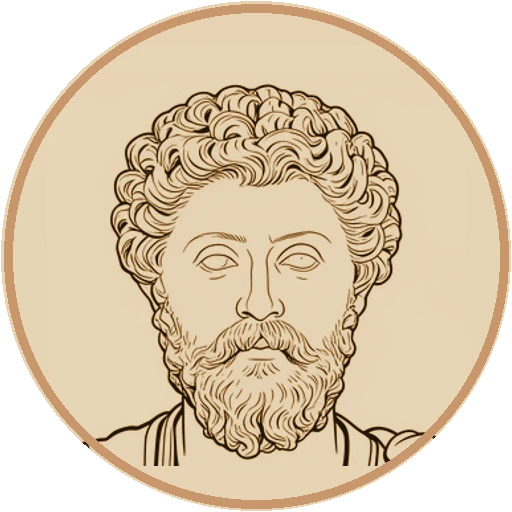
Image: placeholder silhouette pending operator sketch (reference candidates queued in image.license.yaml)
Last reviewed: 2026-05-17 · Page version: 1
Background
Ancient · Historical · Stoicism tradition