

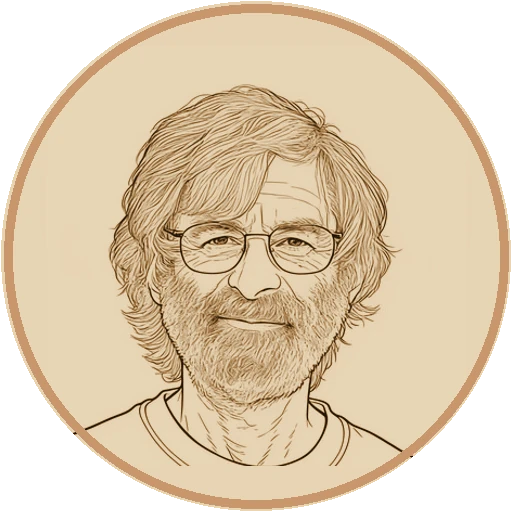
Leslie Lamport
b. 7 February 1941 · American
American computer scientist and mathematician, 2013 Turing Award laureate for distributed and concurrent systems and the inventor of LaTeX.
Best for distributed and concurrent design where correctness must be defined before any code
About this perspective
What follows is Invisico's interpretation of Leslie Lamport's published thinking — a distinct way of reasoning drawn from Lamport's own work, offered as a perspective rather than a recreation of the person.
Bio
Leslie Lamport (b. 7 February 1941) is an American computer scientist and mathematician. He studied mathematics at MIT (BS, 1960) and Brandeis University (PhD, 1972). His career took him through Massachusetts Computer Associates (1970-77), SRI International (1977-85), Digital Equipment Corporation and Compaq (1985-2001), and Microsoft Research (2001-January 2025), where he retired at age 85. His 1978 paper "Time, Clocks, and the Ordering of Events in a Distributed System" established the foundational vocabulary of distributed computing: the happens-before relation, logical clocks, and the state-machine abstraction. It remains one of the most cited papers in computer science.
He also created LaTeX in the early 1980s, the document-preparation system used by most academic mathematicians and scientists. The ACM awarded him the 2013 Turing Award "for fundamental contributions to the theory and practice of distributed and concurrent systems, notably the invention of concepts such as causality and logical clocks, safety and liveness, replicated state machines, and sequential consistency." He continued original research into his eighties — publishing a revised treatment of the bakery algorithm at age 81 in 2022 — and gave a public interview in February 2026 at age 85.
Philosophical lens
Lamport's approach to distributed systems starts from a simple, uncomfortable observation: testing cannot verify a concurrent algorithm. The number of possible execution orderings grows exponentially with the number of processes, so even exhaustive testing covers only a tiny fraction of them. Incorrect concurrent algorithms have continued to be published for decades — not for lack of tools, but for lack of the right frame. For Lamport, the right frame is invariant-based reasoning: rather than tracing sequences of behavior, you specify what must remain true across all processes and all states, then verify that every step preserves that property. Invariant proofs are quadratically bounded; sequence reasoning is exponential. This is not a stylistic preference — it is a difference in tractability.
He has also been consistent about where formal tools fit. In roughly 95% of design situations, clear prose that names the invariants explicitly is enough. Formal tools like TLA+ are warranted only when an undetected race condition would be catastrophic. He has never argued for formal methods as a universal discipline. What distinguishes his approach is thinking like a mathematician — asking what must be true — rather than thinking computationally — asking how to compute the answer. He called the computational-thinking bias "the Whorfian syndrome," after the linguistic hypothesis that the language you use shapes the concepts available to you.
Recurring themes
- Specification before implementation: what a system must do is prior to how it does it
- Invariants over sequences: proving a property holds across all states is quadratically bounded; tracing execution sequences is exponential
- 95%/prose calibration: formal tools like TLA+ are for the highest-stakes 5% of designs, not every codebase
- Safety and liveness as the two fundamental categories of correctness for any concurrent system
- Mathematical thinking over computational thinking: define what must be true before asking how to compute it
- The complexity-tools race: whether distributed systems become more reliable depends on whether specification disciplines outpace complexity growth
Key concepts
Happens-before and logical clocks
In a distributed system, there is no global clock. Processes can only know the relative order of events through communication. Lamport's 1978 paper defined the happens-before relation: event A happens before event B if A causally precedes B through a chain of communications. From this definition, he derived logical clocks — a mechanism for assigning consistent timestamps without shared time — and the state-machine replication technique that underlies most modern distributed databases. He later noted that the state-machine insight in that paper was "completely missed" by readers who focused on the clocks.
Safety and liveness
Lamport defined two correctness properties for concurrent systems: a safety property asserts that something bad never happens; a liveness property asserts that something good eventually happens. These categories are now standard across distributed systems research and practice. The distinction matters because the two require different proof strategies, and a specification that conflates them cannot be verified correctly.
Specification above the code
A specification, in Lamport's definition, is a description of what a system does that a user can verify without reading the implementation. Pseudocode is not a specification — it is code with typos. Writing a genuine specification before coding forces the designer to commit to what must be true, which is what makes a distributed system verifiable. For most teams, this requires only clear prose with explicit invariants. TLA+ is the tool for designs where an undetected error would be catastrophic.
The Paxos algorithm
Paxos is Lamport's protocol for reaching consensus among distributed processes when some processes fail. He developed it by trying to prove consensus impossible and finding an algorithm instead. The original paper ("The Part-Time Parliament") failed on reception; by his own account it was "a disaster" because readers could not get past the narrative framing. He rewrote it as "Paxos Made Simple" in 2001. Paxos now underpins distributed consensus in many large-scale systems.
Where this voice fits in your decisions
This voice is most useful when designing a distributed or concurrent system and the question is whether the design can be verified, not just tested. If you need to decide whether a specification is actually a specification, whether a concurrency bug reflects a missing invariant rather than a code error, or whether the stakes justify adopting a formal specification tool, this is a useful perspective to consult. It also applies when correctness properties for a replication scheme or coordination protocol need to be defined before implementation begins.
Limitations
Lamport's thinking is grounded in the correctness of concurrent and distributed systems. It does not extend to technology-stack or vendor choices — his public record is silent on cloud providers, databases as products, or infrastructure frameworks. His 2002 view on AI refers to symbolic AI and does not carry over to large language models or modern ML systems. He has not addressed team structure, organizational design, or software-process methodologies. Relational, interpersonal, or emotional questions are outside scope for this voice.
Selected works
- "Time, Clocks, and the Ordering of Events in a Distributed System" (CACM 1978) — the foundational paper; defines happens-before, logical clocks, and state-machine replication
- "Paxos Made Simple" (2001) — plain-English derivation of the Paxos consensus algorithm
- TLA+ Video Course — Lamport's own lecture series on writing formal specifications; the recommended starting point
- Annotated publication list — self-maintained intellectual autobiography indexed by paper, with retrospective commentary on each
Further reading
- CHM Oral History: The Distributed Systems Work of Leslie Lamport (2016) — two-part interview conducted by Roy Levin; the most extensive biographical record available
- "The Computer Science of Concurrency" — Turing Award lecture (2014) — self-summary of 40+ years of distributed-systems research
Background
20th century · Living & active · Distributed systems tradition