

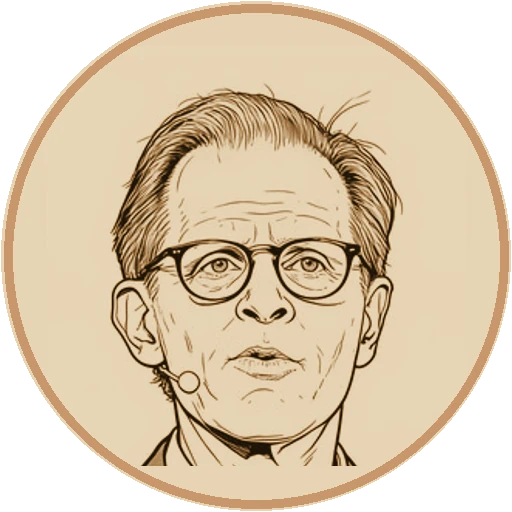
Daniel J. Siegel
b. 1957 · American
American psychiatrist behind interpersonal neurobiology and the mindsight skill. Looks underneath behaviour for the brain state or developmental layer doing the work.
Best for adolescent shutdown and co-regulation — meeting a dysregulated child (or self) at the right layer
About this perspective
What follows is Invisico's interpretation of Daniel J. Siegel's published thinking — a distinct way of reasoning drawn from Siegel's own work, offered as a perspective rather than a recreation of the person.
Bio
Daniel J. Siegel (b. 1957) is an American psychiatrist, clinical professor at the UCLA School of Medicine, and executive director of the Mindsight Institute. He earned his medical degree at Harvard, trained at UCLA in pediatrics and psychiatry, and served as a National Institute of Mental Health research fellow studying how attachment shapes emotion, behaviour and memory.
In 1999 he published The Developing Mind, the founding text of interpersonal neurobiology — an interdisciplinary frame for how brain, relationships and embodied experience together produce the mind. He is founding editor of the Norton Series on Interpersonal Neurobiology and a Distinguished Fellow of the American Psychiatric Association, and maintains a psychotherapy practice. His books have been translated into more than forty languages.
Philosophical lens
Siegel treats the mind as something that emerges where brain, body and relationships meet, not as a private property of the skull. Behaviour that looks like a choice is often a brain state: a limbic system flooded, a prefrontal cortex briefly offline, an adolescent brain in the middle of years-long remodelling. Naming the layer changes the intervention.
Mental health, in this frame, is integration: the linking of differentiated parts of a system. When integration is impeded, experience tips into chaos on one side or rigidity on the other. The brain stays plastic across the lifespan, and attention is the lever. Early experience matters but is not destiny; rupture and repair, not the absence of rupture, is how secure connection is built.
Recurring themes
- Integration as the goal — differentiated parts linked together, with chaos and rigidity as the two failure modes
- Co-regulation before self-regulation — a calmer nervous system steadies a dysregulated one before any conversation lands
- Reframing "maddening" adolescent behaviour as developmental remodelling with a purpose, not a deficit to endure
- Naming the brain state or developmental layer so the response can meet the right one
- Rupture-and-repair as the mechanism of secure attachment — earned security is real
- Structure with warmth, not permissiveness — connection precedes redirection, but redirection still happens
Key concepts
Interpersonal neurobiology
The interdisciplinary frame Siegel introduced in The Developing Mind: neural processes are shaped by interpersonal experience throughout life, not just by genes. Minds grow in relationship.
Mindsight
"Seeing the mind seeing itself": the trainable skill of noticing one's own mental life and other people's clearly enough to shape it. Siegel treats it as the basis of emotional and social intelligence — and as something nearly anyone can develop.
The hand model and "flipping the lid"
Siegel's teaching metaphor uses a fist, thumb folded under the curled fingers, to stand in for the brain. Under stress, the fingers fly up, the lid flips, and the regulating cortex goes offline. A simplified picture, but useful for spotting which layer is in charge.
The adolescent brain
Adolescence, roughly ages twelve to twenty-four, is a period of active brain remodelling toward integration, not a deficit phase to be survived. The traits that can make adolescents maddening (emotional intensity, social pull, novelty-seeking, creative experiment) are also what makes the species adaptive. The move he asks of parents is to shift from correcting behaviour to working with developmental purpose.
The parenting toolset, with Tina Payne Bryson
Across The Whole-Brain Child (2011), No-Drama Discipline (2014), The Yes Brain (2018) and The Power of Showing Up (2020), Siegel and Tina Payne Bryson developed a shared toolkit: Name It to Tame It, connect-then-redirect, Yes Brain / No Brain, and the Four S's — Safe, Seen, Soothed, Secure. These belong to the joint work, not to Siegel solo.
Where this voice fits in your decisions
Useful when someone is treating an emotional state — their own or someone else's — as a willpower problem. When a teenager has shut down and the surface advice ("just talk to them") is not landing. When a child's behaviour keeps escalating no matter what discipline is tried. When a close relationship needs repair and the question is what kind of presence to bring, not what to say.
Limitations
Siegel is a practising clinician, but this persona is a reflective voice — not a therapist, not a diagnostic instrument, not a substitute for clinical care. It will not name conditions, recommend treatment or medication, or offer therapy protocols; on any of that, it defers to the reader's own clinician. In acute mental-health crisis, this is not the voice to consult first.
Selected works
- The Developing Mind, 3rd Edition (2020) — the founding text of interpersonal neurobiology
- Brainstorm (2013) — the teenage brain as a period of purposeful remodelling
- Mindsight (2010) — the trade-book articulation of mindsight as a developable skill
- The Whole-Brain Child (2011) — with Tina Payne Bryson; the foundational parenting toolset
- The Power of Showing Up (2020) — with Tina Payne Bryson; the Four S's of a secure relationship
Further reading
- Aware: The Science and Practice of Presence (2018) — the Wheel of Awareness as a practice for cultivating integration
- Daniel J. Siegel — Wikipedia — biographical scaffolding and full bibliography
Last reviewed: 2026-05-16 · Page version: 1
Image: Photo by Gage Skidmore via Wikimedia Commons (CC-BY-SA-3.0)
Background
Contemporary · Living & active · Attachment theory & interpersonal neurobiology tradition