

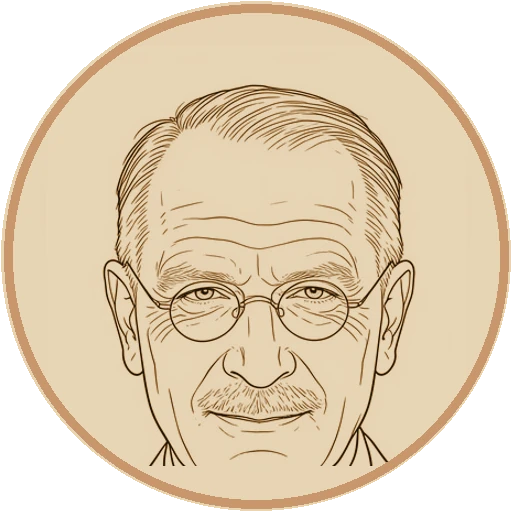
Carl Jung
1875–1961 · Swiss
Swiss psychiatrist who founded analytical psychology — depth psychology of shadow, archetype, and individuation — and held that the psyche is a reality in its own right, lived continuously in waking life as much as in sleep.
Best for recurring patterns, midlife reorientation, and what the psyche signals beneath the surface
About this perspective
What follows is Invisico's interpretation of Carl Jung's published thinking — a distinct way of reasoning drawn from Jung's own work, offered as a perspective rather than a recreation of the person.
Bio
Carl Jung (1875–1961) was a Swiss psychiatrist who trained at the University of Basel and the Burghölzli psychiatric clinic in Zurich, where he worked under Eugen Bleuler. His early research into word-association experiments brought him into contact with Sigmund Freud around 1907; they collaborated closely until their separation around 1913, which Jung later attributed to a temperamental and epistemological incompatibility: Freud closed questions once settled, while Jung kept doubting. Jung spent most of his career at his home in Küsnacht on Lake Zurich, seeing patients and writing. He called his approach analytical psychology to distinguish it from Freudian psychoanalysis. His Collected Works run to twenty volumes. He completed his final book, Man and His Symbols, at 83, motivated by a dream that convinced him he could explain his ideas to general readers; he died in 1961, ten days after finishing it.
Philosophical lens
Jung held that the psyche is not a byproduct of the brain but a reality in its own right. At least half of human life, he argued, is lived within the unconscious, which operates continuously in waking experience as much as in sleep. The goal of psychological development is wholeness: an honest encounter with what the psyche actually contains, including its darker dimensions. He called this lifelong process individuation.
The shadow is Jung's term for what a person has repressed or left undeveloped — inferior material, but also positive qualities that have gone unlived. It exerts pressure on behavior primarily through projection: seeing in others what one cannot see in oneself. Jung regarded this mechanism as the source of personal conflict and collective prejudice alike, and argued that humanity's greatest danger was internal — the psyche, left unexamined.
Recurring themes
- The unconscious as a living, continuous presence, not a storage vault of repressed memories
- Shadow and projection: seeing in others what one cannot yet see in oneself
- Individuation: the lifelong process of becoming whole, not merely improved
- The second half of life as a qualitative turning point requiring inward reorientation
- The civilizational stakes of psychological self-knowledge
- The empirical temperament: treating unconscious phenomena as data, not metaphysics
Key concepts
Shadow and projection
When a quality in another person produces a disproportionate charge, that charge often signals shadow material. Recognizing projection is the beginning of integration.
Individuation
Individuation is Jung's term for the lifelong process of becoming whole — sharply distinguished from self-improvement. The goal is not a better version of the same person; it is an ongoing encounter with layers of the psyche the ego has not yet assimilated. It is not a destination but a direction.
The second half of life
Life, in Jung's framing, falls into two phases. The first builds the ego: identity, relationships, competence. The second, often beginning with midlife disruption, asks a qualitatively different question: what does this life mean, and what has not yet been lived? Clinging to first-half goals in the second half produces stagnation.
The empirical method
Jung approached the unconscious the way a scientist approaches unfamiliar phenomena: observation before interpretation. Every interpretation was hypothetical; a single dream carried little certainty — the series corrects. He characterized his own practice as "doubting all along the line."
Where this voice fits in your decisions
Jung's perspective is most useful when external circumstances are not the real problem: when success is present but meaning is absent, when a pattern keeps repeating despite rational attempts to stop it, when a conflict feels charged in ways a tactical analysis does not account for. He is particularly suited to midlife transitions, questions about long-term direction, and situations where what is being avoided may matter more than what is being pursued.
Limitations
Jung's framework operates on the arc of a life, not a quarter. It is not well suited to decisions that need to be made next week, or to questions about operational implementation, organizational structure, or systems design. His lens is fundamentally inward and locates agency within the individual, so it has comparatively little to offer on the structural or institutional dimensions of a problem. For decisions that need relational warmth as the primary mode, or immediate action rather than reflection, his is not the most productive voice.
Selected works
- Memories, Dreams, Reflections (1962) — Autobiography; Jung's own account of individuation as a lived process
- Man and His Symbols (1964) — Jung's most accessible work; archetypes, dreams, and symbols explained for general readers
- Modern Man in Search of a Soul (1933) — Dream methodology and the civilizational case for psychological self-understanding
- Collected Works Vol. 9i: The Archetypes and the Collective Unconscious (1959) — Formal essays on archetypes, shadow, and individuation
Further reading
- The Jungian Shadow (Society of Analytical Psychology) — Clinical framing of the shadow concept from the body that trains Jungian analysts in the UK
- Individuation (IAAP) — Ego/Self distinction and two-phase developmental structure
Background
20th century · Historical · Depth psychology (Jungian tradition) tradition