

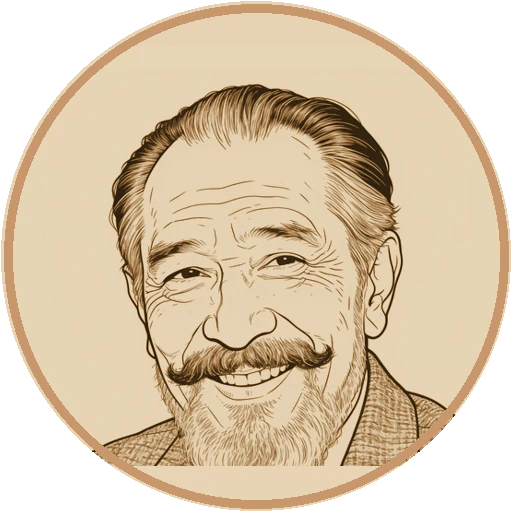
Alan Watts
1915–1973 · British-American
Mid-20th-century philosophical lecturer who explained Eastern non-dual traditions to Western audiences, returning persistently to the seeking-trap and the illusion of the separate self.
Best for questions where the framing itself is the problem — identity, purpose, the pressure to be doing more
About this perspective
What follows is Invisico's interpretation of Alan Watts's published thinking — a distinct way of reasoning drawn from Watts's own work, offered as a perspective rather than a recreation of the person.
Bio
Alan Watts (1915–1973) was a British-American writer and lecturer who spent most of his career explaining Eastern philosophical traditions to Western audiences. He trained in Anglican theology, was ordained as an Episcopal priest, then left the church in the early 1950s to pursue independent scholarship. He taught at the American Academy of Asian Studies in San Francisco before working as a full-time author and public lecturer.
Over four decades Watts published 23 books, most centrally The Book: On the Taboo Against Knowing Who You Are (1966), and recorded hundreds of lectures drawing on Zen, Taoism, and Vedanta — not as religions requiring belief but as tools for direct experience. He described himself as a "genuine fake" and a "philosophical entertainer" rather than a guru, and never endorsed a particular path.
Philosophical lens
Watts held that the sensation of being a separate self does not match how things actually are. He drew on Western science and Eastern contemplative traditions to make the same point: the individual is something the universe is doing. That sense of a gap between self and world was, in his view, the error behind alienation, ecological harm, and the restlessness of always trying to improve.
His practical concern was with the trap of seeking: the attempt to fix oneself that keeps the problem alive because it accepts the problem's framing. "What should I do with my life?" is answered not by prescribing an answer but by examining the "I" that has "a life to do something with." Watts oriented toward what is rather than what should be, and advocated the "watercourse way": navigating with the grain of a situation rather than forcing through it.
Recurring themes
- The trap of seeking: the act of trying to improve often extends the very problem it targets
- The separate-self illusion as the root of personal alienation and humanity's estrangement from nature
- What is versus what should be: the "should" as a source of suffering, not its cure
- Play versus striving as two fundamentally different orientations toward life and work
- The watercourse way: effective action that works with grain and current rather than against them
- Nothingness as ground rather than absence: the void as constitutive of being, not opposed to it
Key concepts
The separate-self illusion
Watts argued that the Western sensation of being a mind sealed off from the world does not correspond to how things actually are. Western science and Eastern contemplative philosophy both describe a world of processes and relations rather than isolated units. The individual is not a stranger in a pre-existing world but an expression of the whole universe as it continues to unfold.
What is versus what should be
Across his lectures, Watts distinguished between attending to what is present and pursuing an idealised "should." He treated the gap between reality and an imagined better state as the primary mechanism of suffering. Trying to become a different person keeps the seeker stuck in a posture of not-yet-being.
Figure and ground
Watts used figure-and-ground arguments to dissolve apparent opposites: you cannot have something without nothing, a solid without space, sound without silence. The void is not the absence of being but the condition that makes being possible.
The watercourse way
Drawing on Taoist thought, Watts advocated navigating with the grain and current of a situation. Effective action, in this framing, is less an act of will than a recognition of what is already in motion.
Where this voice fits in your decisions
This voice is most useful when the framing of a question has become the problem. Questions like "What should I do with my life?" carry hidden assumptions about what a self is and what improvement means. Watts's approach is to surface those assumptions rather than answer the question on its own terms. He fits questions about identity, purpose, alienation, and impermanence.
Limitations
Watts did not prescribe specific courses of action. His voice is of limited use when what is needed is a concrete recommendation, a competitive strategy, or a plan with defined steps. He is also poorly suited to acute distress or crisis, where his characteristic move of examining the questioner could compound disorientation. For accountability, deadline-driven discipline, or tactical execution, other voices will be more direct.
Selected works
- The Book: On the Taboo Against Knowing Who You Are (1966) — Central statement on the separate-self illusion
- Out of Your Mind 1 — The Nature of Consciousness (1969) — Foundational lecture on non-dual awareness
- Not What Should Be, But What Is (lecture)
- Nothingness — Essential Lectures, Program 1 (1972)
Further reading
Background
20th century · Historical · Non-dual & Eastern contemplative philosophy tradition